
Technique & heavy bag training
Why Some Punches Sound Better on the Heavy Bag
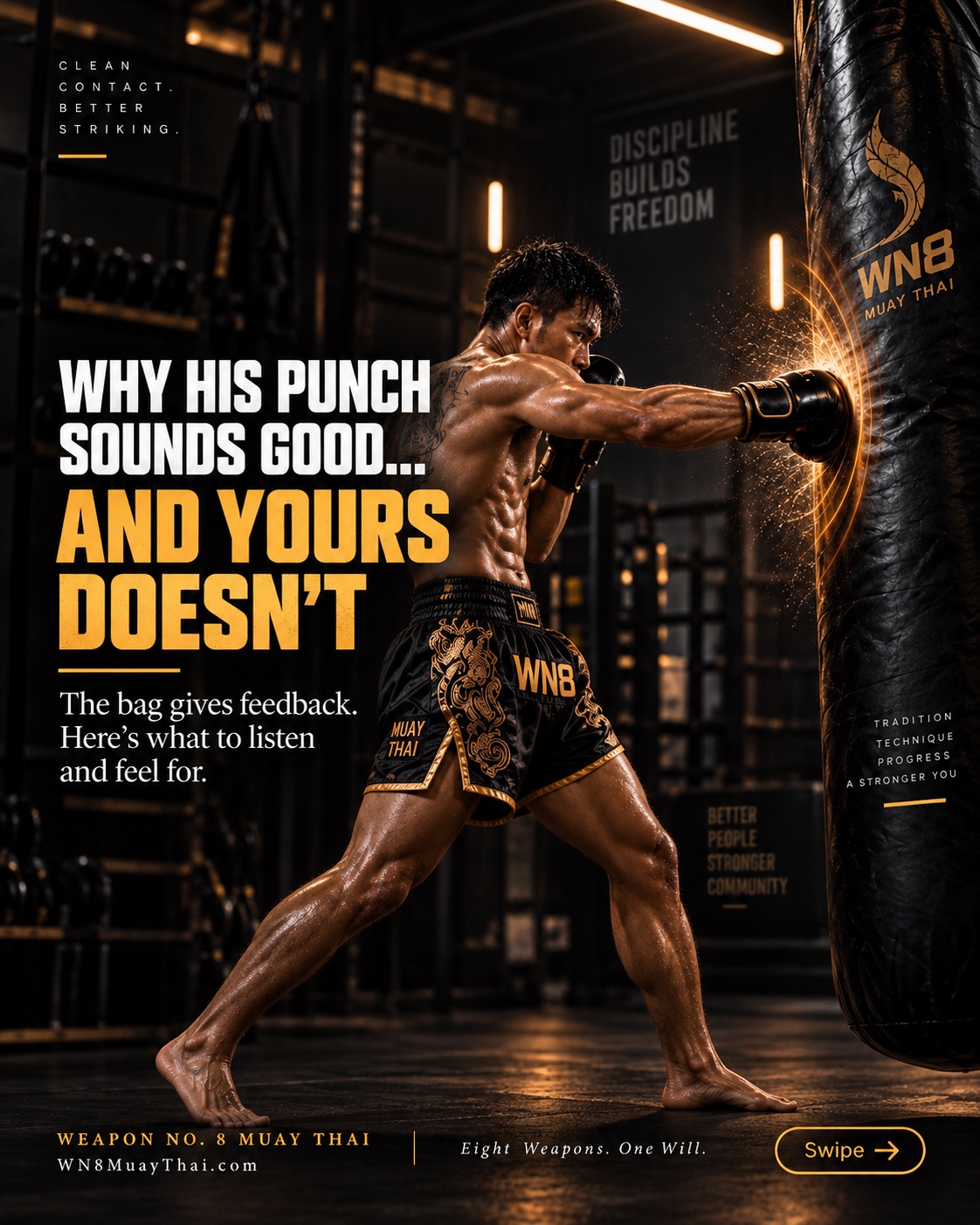
Walk into almost any Muay Thai gym and you’ll hear it.
One person hits the heavy bag and gets a dull thud.
Another person throws what looks like the same punch and—
CRACK.
The entire gym hears it.
It’s easy to assume the louder fighter is simply stronger. Sometimes they are. But often, that clean sound has more to do with how the strike lands than how hard the person is trying to hit.
Your gloves—and the heavy bag itself—can give you immediate feedback about your technique.
The Bag Is Talking Back to You
A well-landed punch transfers force into the target cleanly.
When the wrist, fist, forearm, shoulder, hips, and body are working together, the impact tends to feel solid and often produces a sharper sound.
Poor contact usually feels different.
The wrist may bend.
The punch may land across the wrong part of the glove.
The fist may slide across the surface.
Or the fighter may push the bag instead of striking through it.
That often produces a softer, heavier thump instead of a crisp impact.
Think of the sound as feedback.
Not a score.
Not proof that you hit harder than everyone else.
Just another piece of information your body can learn from.
What Creates That Clean “Crack”?
Several things are happening at the same time.
1. Proper Knuckle Alignment
For most punches, you want the impact traveling through the strongest structure possible.
The fist, wrist, and forearm should be aligned rather than allowing the wrist to collapse on contact.
When everything is stacked correctly, energy travels into the target instead of being lost through poor positioning.
Your gloves can hide small mistakes, but they can’t completely hide bad alignment.
If the punch feels unstable inside the glove, pay attention.
2. Clean Contact
A clean punch hits the target instead of brushing, scraping, or sliding across it.
That difference matters.
A punch that lands flat and cleanly transfers energy quickly.
A punch that skims across the bag spreads that impact out and wastes force.
Sometimes the difference between a dull hit and a beautiful crack is only an inch of positioning.
3. Speed Matters
Power isn’t just about strength.
A technically sharp punch accelerates into the target.
This is why an experienced fighter who isn’t especially large can make the bag sound violent while a much stronger beginner may struggle to get the same response.
The experienced fighter has learned how to combine:
- balance
- timing
- rotation
- acceleration
- structure
- relaxation
- contact
The strike arrives together.
4. Rotation and Body Connection
Good punching doesn’t come only from the arm.
The floor, legs, hips, torso, shoulder, arm, and fist all contribute.
When those pieces connect properly, the punch feels like one movement rather than several separate movements happening at once.
For example, a clean rear cross usually has far more behind it when the hip and shoulder rotate with the strike instead of the arm reaching forward by itself.
That connection is one of the biggest differences between hitting the bag and actually striking it.
5. Relaxed Before Impact. Structured at Impact.
One of the most common beginner mistakes is trying to stay completely tense while punching.
It feels powerful.
Usually it isn’t.
Excess tension can slow the strike down.
Experienced fighters often stay relatively relaxed during the movement, allowing the punch to accelerate, then create structure as the strike lands.
Fast into the target.
Stable through the target.
Then relaxed again.
That rhythm is a huge part of efficient striking.
The Gloves Give You Feedback Too
A good pair of gloves does more than protect your hands.
Over time, you begin to recognize how correct contact feels inside them.
A properly landed punch may feel compact and solid.
Poor contact might feel like the glove twists.
Your wrist may feel unstable.
Your knuckles may feel like they landed at an angle.
The glove might slide across the bag instead of planting cleanly.
That information is valuable.
The goal isn’t to chase the loudest possible sound.
The goal is to repeatedly create clean, balanced, structurally sound contact.
The sound sometimes comes with it.
But Don’t Judge Technique by Sound Alone
This part matters.
A loud bag does not automatically mean perfect technique.
Different bags produce completely different sounds.
A dense Thai bag might give you a heavy thump.
A lighter hanging bag might produce a sharp pop.
Leather, synthetic leather, padding, room acoustics, glove padding, bag age, bag fill, and even how the bag is hanging can change the sound dramatically.
Different techniques also sound different.
A jab isn’t necessarily going to sound like a rear cross.
A body hook won’t necessarily sound like a straight punch.
A round kick can produce anything from a deep boom to a sharp slap depending on the bag and where the shin lands.
So don’t train just to make noise.
Train to make good contact.
Stop Trying to Murder the Bag
Another mistake we see constantly is people trying to throw every strike at 100%.
The harder they try, the worse the technique becomes.
Their balance disappears.
The shoulders tighten.
The hands drop.
The punches start pushing.
The feet stop working.
Instead, slow it down.
Find the contact.
Then add speed.
Then add power.
A technically clean strike at 60–70% teaches you far more than throwing wild shots at maximum effort.
Once the mechanics are right, power becomes much easier to develop.
A Simple Heavy Bag Test
Next time you train, try this.
Throw ten rear crosses at moderate power.
Don’t worry about destroying the bag.
Instead, pay attention to four things:
- Did the wrist stay straight?
- Did the glove land cleanly?
- Did the hips and shoulder rotate together?
- Did you stay balanced after the strike?
Listen to the sound too.
When everything lines up, you’ll often notice that certain punches suddenly sound different.
That’s your body beginning to understand clean contact.
Now repeat it.
Again.
And again.
That repetition is where technique becomes instinct.
The Goal Isn’t to Hit Harder. It’s to Hit Better.
Power eventually matters.
Of course it does.
But good striking starts with structure, timing, balance, accuracy, and proper contact.
When those things improve, something interesting usually happens:
You stop trying so hard to hit harder.
And somehow—
you start hitting harder anyway.
At Weapon No. 8 Muay Thai, we teach students to understand why a technique works, not simply memorize movements.
Learn the mechanics.
Listen to the feedback.
Make every repetition count.
Eight Weapons. One Will.
Weapon No. 8 Muay Thai WN8MuayThai.com